


All Activity
- Today
-

-
We’ve enhanced the Audit log table by adding the ability to view the virtual actor directly in the actor column. This update applies to both users and applications, providing greater clarity and transparency when reviewing activity log. BenefitsThis would enhance visibility of the actors and foster familiarity. With this improvement, you can easily identify actions performed by virtual actors alongside traditional users and applications, streamlining your audit and monitoring processes.
-
-
-
-
- Yesterday
-
 °DR_SCU joined the community
 -
You can now connect Jira, Confluence, and Compass to ChatGPT using the built‑in Atlassian Rovo connector - no developer mode required. To start using Atlassian Rovo MCP in ChatGPT: In ChatGPT, go to Profile → Settings → Apps & Connectors. Find Atlassian Rovo and select Connect. Sign in with your Atlassian account, then choose which apps and sites ChatGPT can access. Start a new chat and add Atlassian Rovo to use Jira, Confluence, and Compass in ChatGPT. Key changesNo developer mode needed: Atlassian Rovo is now a built‑in ChatGPT connector, so users no longer need to enable developer mode or configure a custom MCP client. Simple, guided setup: Users can connect via Apps & Connectors, then approve access to specific Atlassian apps and sites using an OAuth flow. Works across ChatGPT experiences: The connector can be used in standard chats, Deep Research, and Agent mode to read from and act on Jira, Confluence, and Compass (where enabled). How to prepare for the changeReview your organization’s policies for third‑party connectors in ChatGPT. If needed, share internal guidance on when and how people should enable the Atlassian Rovo connector and which Atlassian sites they should connect.
-
-
-
We are introducing a feature to allow non-admin users to create and edit bookmarks from popular search query suggestions in Confluence and Atlassian Home. If there is a commonly searched for term (without a bookmark), users will be prompted from search to add a link.
-
Jira now lets Collaborator users comment on work items by default in new Customer Service Management (CSM) spaces. This makes it easier for support and project teams to share updates and collaborate in one place. You don’t need to do anything for new CSM spaces. To give Collaborators the Add comments permission in existing CSM spaces: In the CSM space, go to Space settings and choose Details. If you see the message This service project has configuration problems and may not work as expected, select View error details and repair the problem, then Show errors. When you see The Collaborator role is missing standard permissions: Add Comments, select Fix permission. If you or another admin previously selected Ignore error, follow these steps instead: In the CSM space, go to Space settings > Access > Space permissions. Select Actions > Edit permissions. Under Project permissions, next to Browse projects, select Update. Choose Space role, select Collaborator, then select Update. Under Comments permissions, next to Add comments, select Update. Choose Space role, select Collaborator, then select Update. Key changesNew CSM spaces now give the Collaborator role the Add comments permission on work items by default. BenefitsKeeps Collaborator permissions aligned when you use Forward work, so Jira users can collaborate more effectively with customer service agents on escalated work. Cuts down on manual permission changes for admins managing CSM Collaborator users. Lets collaborators share updates directly on work items in Jira, improving cross-team visibility.
-
You can now adjust how content is dispalyed on your pages and live docs using the compact density setting. This setting slightly reduces font size and spacing so more content fits on your screen, making it easier to scan, compare, and edit detailed content. This improvement will be automatically applied by default to legacy editor pages. To adjust your pages and live docs using the compact density settings: Open any page or live doc in your editor and enter the Edit mode. Select the Compact density icon in the toolbar.
-
Keep your Jira work items up to date by syncing conversations from Slack directly to Jira comments, or comments to threads. When you paste a work item link in a Slack channel, select Sync thread to connect the discussion. Replies in Slack will appear as Jira comments, and Jira replies will sync back to Slack, so your team never loses context. To get started, paste a link to a Jira work item in a public or private Slack channel and follow the steps.
-
You can now open a preview panel to view and interact with related content—like teams, goals, projects, and Jira work items—without leaving your current view in Confluence. This makes it easier to stay focused and keep your workflow moving. To use the global preview panel in Confluence: Hover over a smartlink and click on the “Preview” icon. Only smartlinks on Pages and Live Docs are supported today, but support for Whiteboards and Databases will come soon. Supported smartlink objects include Confluence pages and live docs, Teams, Goals, Projects, and Jira work items. The preview panel will open on the side, letting you view and interact with the linked content without opening a new tab or modal. Key changesPreview panels for Smartlinks Capability to interact with Atlassian objects within a Confluence page or live doc BenefitsStay in context: View and edit related content from other Atlassian apps directly in Confluence, so you don’t lose your place or break your flow. Consistent experience: Enjoy a unified preview panel design across Confluence and Jira, making it easier to navigate and understand linked information. Fewer tabs and modals: Reduce clutter by opening related content in a side panel instead of a new tab or full-screen modal. Quick actions: Comment, edit, or update linked content right from the preview panel, saving time and clicks. Reason for the changeWe’ve made these improvements in response to what we heard from you during shared feedback and recent usability studies. How to prepare for the changeYou don’t have to do anything. You’ll see the “preview” option start rolling out across Smartlinks soon.
-
The Program board within Plans now displays column headers using the earliest start and latest end dates from the sprints in each column. To explore the updated Program board date headers: Open the Program board in Jira Plans (Premium and Enterprise only). Look at the column headers to see the new date ranges, which now reflect the earliest start and latest end dates of the sprints in each column. Select a column header to see details about how these dates are determined. Key changesColumn headers now show sprint-based dates – The Program board column headers display the earliest start and latest end dates from the sprints in each column. Column headers can be selected – Selecting a column header opens details that explain where the displayed dates come from. BenefitsImproved clarity for planning – You can quickly see the full date range for all sprints in a column, making it easier to plan and coordinate work items. Greater transparency – You can view clear information about how the dates are calculated, so you always know what you’re looking at. Faster access to sprint details – You can get more context about sprint timing without leaving the Program board.
-
In Confluence search, you can now filter results based on the person who last updated the content.
-
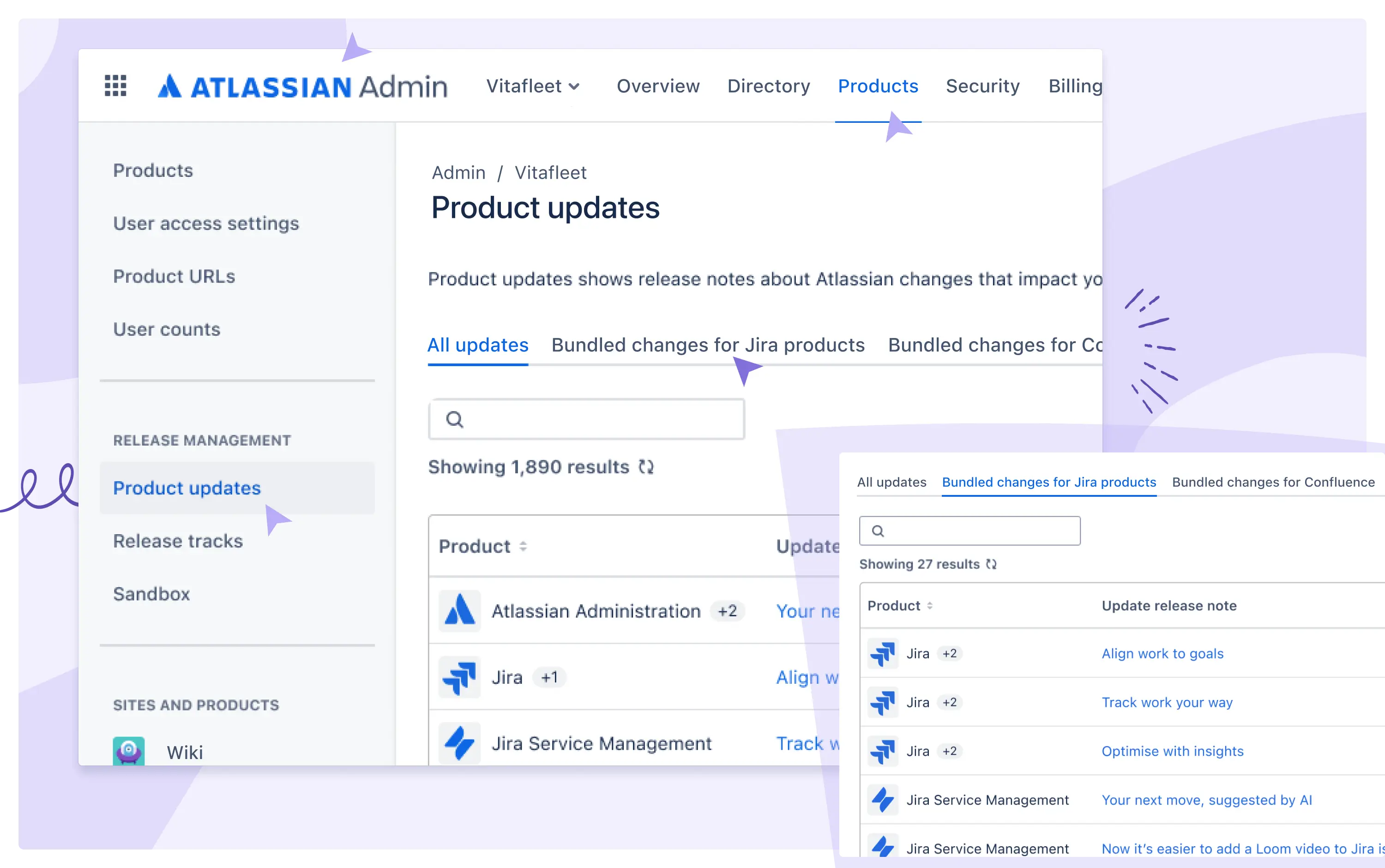 If you have products on the bundled track and continuous track, you can view information about all the changes in one place – no need to switch between Release tracks and Product updates. With the new table layout and the search and filter options, you’ll also be able to find what you’re looking for faster. How to manage product release tracks To view bundled changes for Jira products or Confluence: Go to admin.atlassian.com. Select your organization if you have more than one. Select Products > Product updates. Select Bundled changes for Jira products or Bundled changes for Confluence.
 -
You can now suspend, restore, or delete sandboxes for Jira Software and Jira Service Management separately. Lifecycle actions on one app’s sandbox no longer affect the other, giving admins more control and reducing the risk of accidental changes across Jira family apps. To manage your Jira Software or Jira Service Management sandbox independently: Go to admin.atlassian.com and select your organization. Select Products, then Sandboxes. Choose the sandbox for Jira Software or Jira Service Management. Select the action you want to perform (suspend, restore, or delete). Key changesEach sandbox is now managed separately. Suspending, restoring, or deleting a sandbox only affects the selected app. Existing sandboxes remain active. After this change, any new actions you take will apply only to the chosen app’s sandbox. Unrelated admin experiences are unchanged. Only sandbox lifecycle management is affected. BenefitsGreater control for admins. Manage Jira Software and Jira Service Management sandboxes independently. Reduced risk of accidental changes. Avoid unintended suspensions or restores across multiple Jira family apps. Clearer operations. The admin experience now matches your intent for each app.
-
-
-
-
You can now add cover images to your work items in software and business spaces. Choose from colors, gradients, Unsplash photos, or upload your own image to make your boards more visually engaging and easier to scan. To add a cover image to a work item: Select More actions (...), then Edit cover image. Choose a color, gradient, Unsplash photo, or upload your own image. Save your changes.
-
The Billing Preview page in Atlassian Administration has been updated to deliver a more intuitive experience and faster performance. These improvements help administrators manage billing details more efficiently and with greater ease. To explore this change: Go to Atlassian Administration. Select your organization if you have more than one. Select Billing, then choose Preview to view the updated page. Key changesEnhanced usability for the Billing Preview page. Improved page load times and responsiveness. BenefitsAdministrators can review billing details more quickly and accurately. Faster page performance reduces wait times and improves productivity.
-
The Program board within Plans now displays column headers using the earliest start and latest end dates from the sprints in each column. To explore the updated Program board date headers: 1. Open the Program board in Jira Plans (Premium and Enterprise only). 2. Look at the column headers to see the new date ranges, which now reflect the earliest start and latest end dates of the sprints in each column. 3. Select a column header to see details about how these dates are determined.
-
Confluence email notifications now feature improved subject lines for batched emails. These updates make subject lines more concise and descriptive, helping users quickly identify the purpose of each email and extract value directly from their inbox. To get started with this change: Trigger a notification in Confluence, such as editing a page, mentioning a user, or waiting for a scheduled digest or recommendation email. Check your inbox for the updated subject lines in Confluence notification emails. Key changesSubject lines for batched emails are now shorter and more descriptive. The subject line highlights key details, such as content titles, contributors, or the type of update. The Confluence prefix has been removed from the beginning of subject lines for a cleaner look. BenefitsQuickly understand the purpose of each Confluence email notification at a glance. Easily identify important updates and take action faster. Reduce inbox clutter with clearer, more relevant subject lines.

